
Cancer registries today are caught between demand for more accurate oncology related data and catching up on the backlog, all with limited resources. As case volumes climb and reporting requirements grow more complex, programs that still rely on manual processes are finding it increasingly difficult to stay current. In response, a growing number of AI cancer registry software vendors have entered the market with bold claims, and it can be difficult for registry leaders to separate meaningful capability from marketing noise.
One metric that has gained considerable traction is single-report processing speed. Some solutions advertise casefinding times of seconds per report, positioning raw speed as the defining measure of value. But for the cancer registrars and Oncology Data Specialists (ODSs) managing enterprise-scale workloads, the question is not how fast a system processes one report. It is whether that speed translates to operational efficiency across hundreds or thousands of records, with the accuracy to make the results trustworthy.
Speed That Scales
Processing a single pathology report quickly is a useful capability, but it is not a meaningful proxy for real-world registry performance. Cancer programs don't operate one report at a time. They process incoming volumes from multiple source systems simultaneously, often under tight accreditation and submission deadlines.
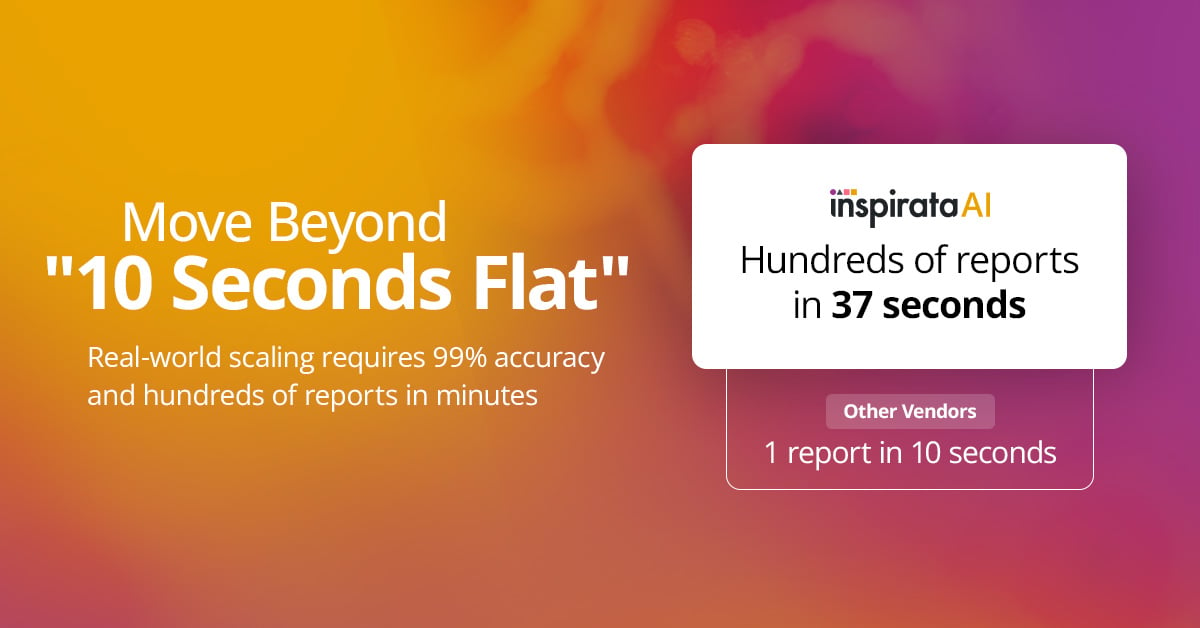
Inspirata AI’s platform is designed for this reality, handling hundreds of pathology, radiology, and clinical reports in less than a minute to deliver real-time cancer casefinding at a pace that matches operational demand. That capacity allows registry teams to streamline workflows and significantly reduce backlogs.
For registries already stretched thin, a workflow designed to absorb high-volume surges without becoming a bottleneck is far more valuable than a stopwatch metric that breaks down at scale. When processing speed is built for volume from the start, cancer registrars can keep pace with increasing caseloads without adding staff or falling behind on submission timelines.
Comparison of outcomes between a competitor and Inspirata AI + ONCO:
- Automated source capture: Competitor, no. Inspirata AI + ONCO, yes.
- Automated pre abstraction: Competitor, assisted only. Inspirata AI + ONCO, yes.
- Reduces manual workload: Competitor, partial. Inspirata AI + ONCO, yes.
- Eliminates system handoffs: Competitor, no. Inspirata AI + ONCO, yes.
- Reduces backlogs: Competitor, no. Inspirata AI + ONCO, yes.
- Scales without staff growth: Competitor, limited. Inspirata AI + ONCO, yes.
- Report processing speed: Competitor, 1 report in 10 seconds. Inspirata AI + ONCO, hundreds of reports in 37 seconds.
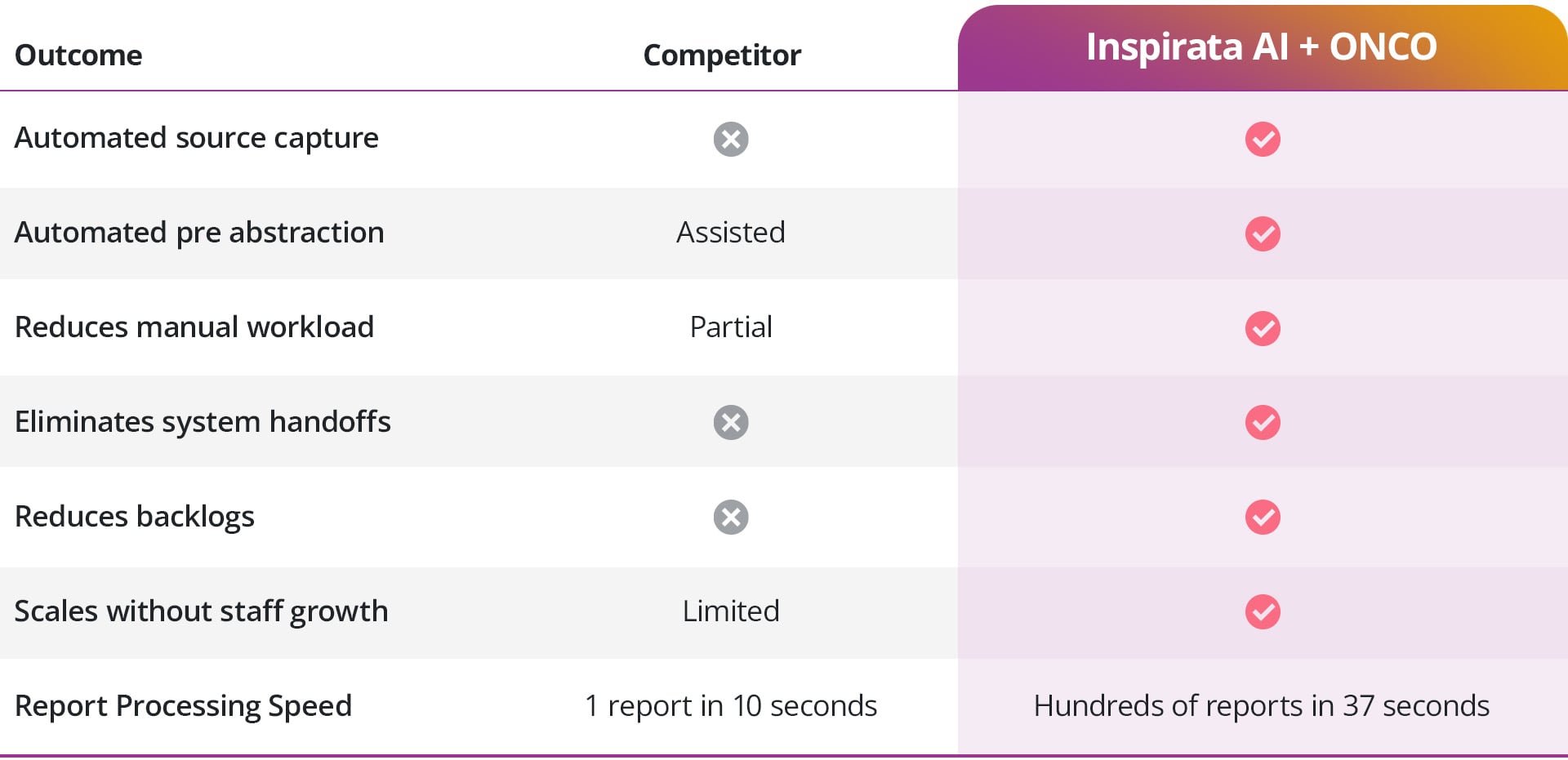
Figure 1: Single-report speed metrics address only one dimension of registry efficiency. Scalable, high-volume processing with validated accuracy is what enables cancer registries to eliminate backlogs and meet reporting demands.
The Accuracy Imperative
Speed without accuracy creates its own problems. When AI cancer registry software misidentifies cases or misinterprets complex clinical language, the result is a downstream quality assurance burden that offsets any time saved during casefinding. The cancer registrar still ends up reviewing, correcting, deduplicating and reprocessing records manually.
This is where the underlying technology becomes critical. Many newer entrants rely on large language models alone, but LLMs can struggle with the nuanced, unstructured data found in clinical reports. They may oversimplify complex clinical criteria, struggle to read and extract meaning from non-standard document formats, or lack the domain-specific knowledge to interpret diagnostic data.
Inspirata AI takes a different approach, combining rules-based native AI, natural language processing, and large language models into a hybrid engine built on more than 20 years of oncology-specific development. This hybrid architecture is engineered to handle the complexity of clinical data, integrating clinical logic and oncology knowledge to achieve 99% accuracy in automated casefinding. Accuracy at this level reduces the need for manual rework, allowing ODS teams to spend less time correcting errors and more time on greater collaboration, education, quality improvement, and support of broader oncology initiatives.
End-to-End by Design
A common narrative in the market suggests that established oncology data management platforms are simply bolted-together third-party tools with fragmented workflows and divided support. It's a convenient claim for newer entrants, but it overlooks the depth of integration that defines a purpose-built oncology platform.
Inspirata AI and ONCO's end-to-end cancer registry solution was created through decades of oncology-specific knowledge and state-of-the-art development tools. Automated casefinding, data abstraction, and reporting operate within a single, cohesive platform where data flows from source capture through final submission without manual handoffs or system-to-system transfers. Support, updates, and compliance are managed in a single platform rather than split across vendors, giving registry teams a unified operational foundation. Additionally, it allows cancer programs to grow their caseload capacity without growing their team while expanding the registry's role from reporting function to strategic asset.
Meeting the Real Demands of Registry Operations
The conversation around AI cancer registry software has too often focused on isolated performance claims rather than the operational realities cancer registrars face every day. Registries don't need a faster stopwatch. They need scalable throughput, validated accuracy, and a streamlined end-to-end platform that empowers skilled staff to work at the top of their license.
Inspirata’s AI enabled solution delivers all three. Our E-Path and E-Path Plus solutions automate casefinding and abstraction with the speed, accuracy, and integration that cancer programs require at scale. While some platforms are new entrants riding the AI wave, Inspirata AI's proven platform draws on over 20 years of dedicated development in oncology data management, engineered to advance the work that cancer registries do for patients, research, and public health.
Watch our recent webinar to learn how the Inspirata AI and ONCO end-to-end solution is transforming cancer registry operations.